
How fermentation works
Your dog is not what they eat. It's what they can absorb.
Why most gut support passes straight through, and what two weeks of wild fermentation changes about a vegetable.

The problem
Plants don't easily digest on their own.
Here's an easy example: give a dog a chunk of carrot or a whole blueberry and look at the lawn the next day. The pieces come out the way they went in. A dog's digestion can't open plant cell walls, so most of what's inside a vegetable never reaches them.
It's the same with isolated probiotic strains in a chew or capsule: they tend to pass straight through. Nothing stays unless there's somewhere to stay.
The mechanism
What two weeks of fermentation does
- grain
Pre-digests the plant
Breaks down the cell walls, so the nutrients inside are open and ready to absorb.
- science
Creates probiotics and postbiotics
Fermentation makes them. Every blend also contains prebiotics, the fiber that feeds the good bacteria.
- spa
Makes nutrients bioavailable
The fiber in whole fermented foods gives beneficial bacteria somewhere to settle, so more of them can settle in.
- cookie
Slightly sweeter
Fermented vegetables taste a little sweeter, which is why most dogs reach for them.
- compress
Concentrates it
One ounce of powder is concentrated from about one pound of fresh produce. Boost™: concentrated from 7½ lbs of ingredients.
- eco
Gives microbes a home
The fiber in whole fermented foods gives beneficial bacteria somewhere to settle, so they stay.
From the field to the teaspoon
Four steps, and one of them is a trade secret.
-
1 · Whole organic foods
Vegetables, roots, fruit, herbs, grasses and sprouts from farms we know. Organic and clean, with nothing synthetic.
-
2 · Ground fine
Everything is ground to a baby-food consistency first, so fermentation can reach every cell. There are billions in a single head of broccoli.
-
3 · Wild fermentation, two weeks
All of the ingredients ferment together as one batch. Our proprietary wild fermentation process, developed over years by our three master fermenters, is one of our most closely guarded assets.
-
4 · Gently dried, then the bowl
A gentle dry locks it in. One teaspoon per 20 lb of dog, over any food. Add, stir, and serve.

The ancestral case
Dogs have always eaten fermented food.
For millions of years dogs ate the gut contents of their prey, largely plant matter, already fermented. They bury bones and dig them up weeks later for the same reason. Fermented food is instinct, and the slightly sweet taste is the giveaway.
Modern bowls, even raw ones, almost never include it. Fermented food does not need to be half the bowl; a teaspoon a day is the whole idea. It doesn't need to be half the bowl.
Prebiotics, probiotics, postbiotics: the plain version
Prebiotics are the fiber that feeds the good bacteria. Every Gussy's Gut fermented blend contains them, from a different mix of vegetables, herbs, grasses and sprouts in each formula.
Probiotics are the bacteria themselves, and postbiotics are the useful compounds they make. Our proprietary fermentation process creates both. We don't add isolated strains, and we're not a probiotic company: whole fermented foods work across a far wider spectrum of bacteria than any single- or multi-strain product can.
A fair comparison
Fermented whole foods vs. the alternatives
| Gussy's Gut Boost™ | The DIY bowl | A typical probiotic chew | |
|---|---|---|---|
| What's in it | 18 whole fermented organic superfoods | Steamed or puréed veg, pumpkin, kefir | A few isolated strains, plus binders and flavorings |
| How it feeds the gut | Fermentation creates probiotics and postbiotics; the fiber gives them a home | Depends on what you made that week | Transient strains that pass through |
| Prep time | 1 teaspoon, stir, done | Shopping, steaming, puréeing, freezing | None |
Why probiotics alone fall short
You can't bottle gut diversity.
Science has identified roughly 500 bacterial species and 1,000 subspecies in a dog's gut, and the real number is probably far higher. Manufacturing can produce only a couple of dozen of them, because only the hardiest strains survive an industrial vat. Those are the ones that need the least help. The delicate species that medications, parasites and stress knock out can't be made in a factory at all.
Give the same strain long enough and you risk a mono-culture: one species crowding the garden. Gut health is diversity, not dominance. One study found that only 2 of 25 veterinary probiotics tested, about 8%, met their own label claims (Weese & Martin, 2011).
The biggest supplement of all is still the outdoors: grass, soil, streams, other dogs. We fit alongside that, not in place of it.
The gut lining
A solid wall, or a chain-link fence.
Think of the gut lining as a fence. Healthy tight junctions are a solid wall: what should stay inside the gut stays inside, and leaves in a poop bag at the dog park. An unhealthy lining is a chain-link fence with holes, and things that belong in the gut can pass into the bloodstream instead.
Most products address one side of this. Our formulas do two jobs at once: support the lining, and feed the beneficial bacteria that live beside it.
Could you do this at home?
Yes. Here's what it takes.
We're evangelists for fermentation first and a company second. If you want to ferment vegetables for your dog yourself, we'll cheer you on. For most households, here's the honest math.
About two weeks per batch
Plus the shopping, the chopping and the food processing, every batch.
It keeps for a few weeks
Home-fermented vegetables spoil. Our powders last two years unopened and a year opened, with no preservatives.
Worth it for a big pack
Three or more large dogs, or five to seven small ones, can justify the kitchen time. For one or two dogs, a teaspoon is the practical answer.
Questions
Common questions
Which product do I start with?
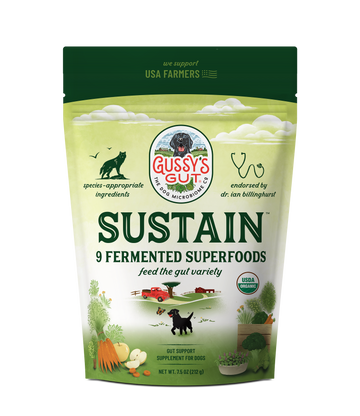
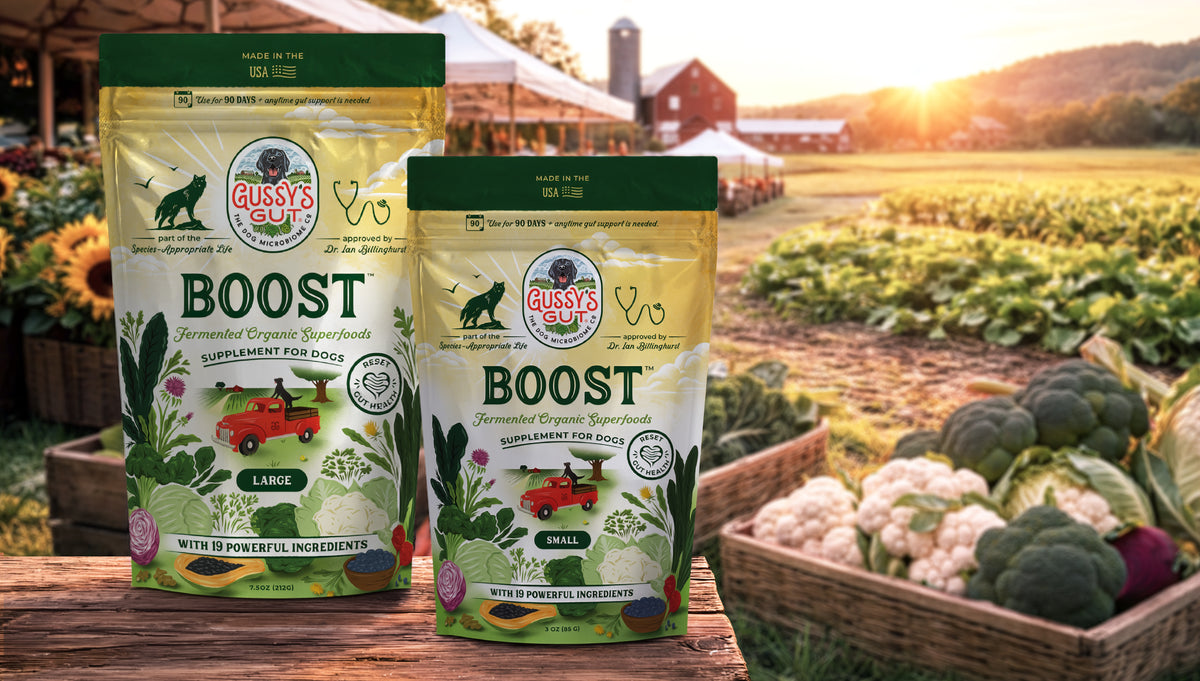
Boost™. It's the G in GROW: the ground you plant everything else in. Feed it for the first 90 days, then move to Sustain™ to keep the garden going. Youthful Grasses & Sprouts™ adds variety alongside either, and Fiber & Fortifier™ tends the soil with whole-food fiber.
Why 90 days?
Cell turnover takes time. The microbiome shifts gradually, and nutrients need time to be absorbed before you can see the difference. Most dietary changes, for people too, need about 90 days to show. Feed it every day, without a break, then judge. If you're not willing to give it 90 days, this product may not be right for you.
How much do I feed?
1 teaspoon per 20 lb of body weight, once a day, for every powder. Sustain™ is ½ teaspoon per 20 lb; Fiber & Fortifier™ is 1 teaspoon to 1 tablespoon per 20 lb, depending on how much fiber your dog needs. Mix it into food with a splash of water, never dry, and never cook it.
Does fermentation change the taste?
A little, in a good way. Fermented vegetables are slightly sweeter, which is why most dogs take to the powder straight away.
Is lower sodium something you aim for?
Our wild fermentation process is designed to minimize the sodium typically produced during fermentation. Beyond that, the method itself is a trade secret we protect.
Is this a probiotic?
No, and we don't position it as one. Our blends contain prebiotics, and the fermentation creates probiotics and postbiotics. The difference is whole food versus isolated strains.